CO2ol Down and Co-Create: How Carbon Market Watch put together a unique process of EU policy co-creation
And how Dreamocracy assisted Carbon Market Watch in shaping EU Carbon Dioxide removal finance
As the urgency to address climate change accelerates, carbon dioxide removals (CDR) are becoming an indispensable tool in EU climate policy. But crafting effective financing frameworks for permanent removals is complex, requiring input from scientists, policymakers, civil society, and industry alike. This is where policy co-creation, a collaborative approach to designing policy, steps in.
In 2025, Carbon Market Watch (CMW) teamed up with Dreamocracy, specialists in collaborative policy design, to lead CO2ol Down Phase 2: a co-creation process focused on developing financing strategies for carbon dioxide removals within the EU.
What is policy co-creation. And why it matters.
Policy co-creation refers to the structured collaboration of diverse stakeholders to jointly design policy frameworks that are robust, inclusive, and implementable. Instead of isolated expert drafting, co-creation involves shared decision-making, ensuring outputs reflect collective expertise and shared ownership.
For the complex topic of carbon removal financing, this process is particularly valuable. With technical uncertainties, ethical considerations, and strategic trade-offs at play, co-creation empowers participants to shape policy features collaboratively rather than having them handed down from distant institutions.
Dreamocracy’s role was critical in facilitating and structuring this co-creation process, helping Carbon Market Watch orchestrate multi-stakeholder dialogue and extract shared insights that feed directly into EU policymaking debates.
CO2ol Down Phase 2: collaborative workshops in Brussels
Workshop 1: short-term financing strategies
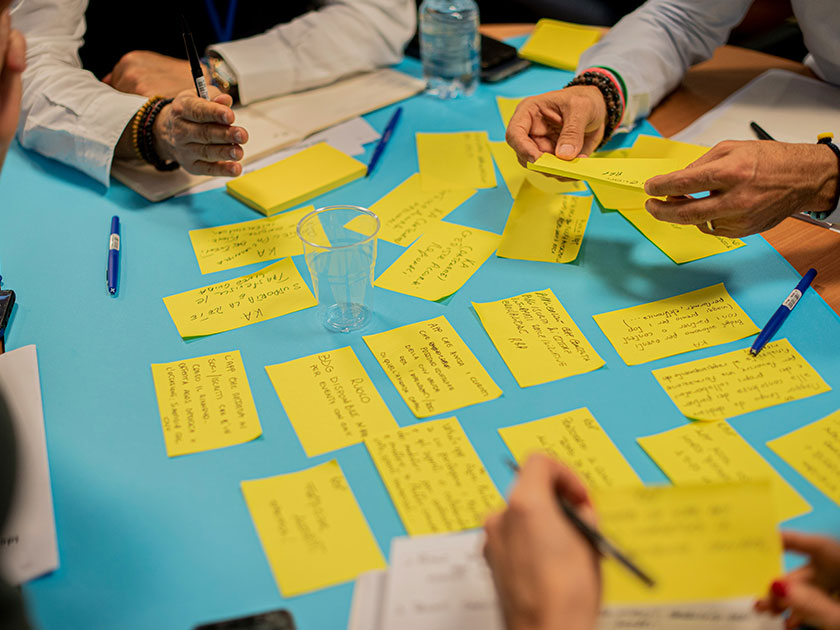
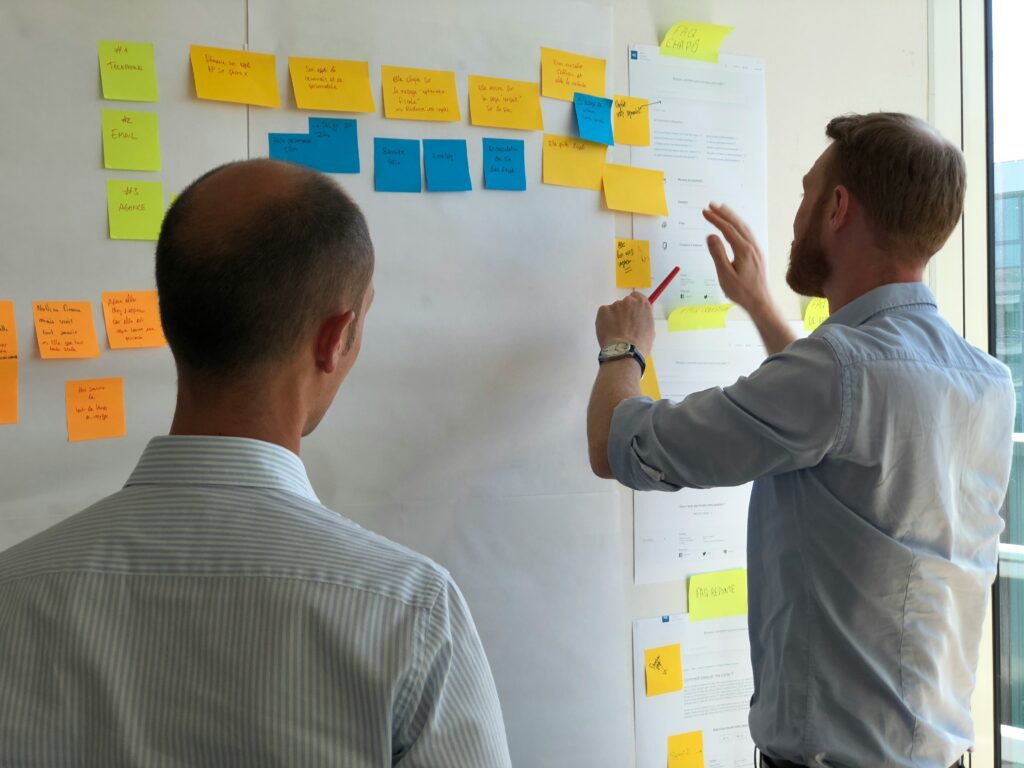
On 22 May 2025, policy co-creation kicked off with the first CO2ol Down Phase 2 workshop in Brussels. Organised by Carbon Market Watch and supported by Dreamocracy, this session brought together experts from academia, civil society, and industry to discuss near-term strategies for financing permanent carbon removals.
During this interactive workshop:
CMW set the context by outlining key design elements for an EU CDR Development and Delivery System that can serve short-term and medium-term needs.
Participants debated criteria for eligible removal methods, governance mechanisms, financing sources, and the political feasibility of various instruments.
Sub-groups explored principles like technological readiness, permanence, and transparency, critical for financing frameworks that maintain climate integrity.
Thanks to Dreamocracy’s facilitation, discussions maintained focus yet flexibility, enabling participants to explore diverse viewpoints while progressing toward common ground, a hallmark of effective policy co-creation.
Workshop 2: long-term delivery framework
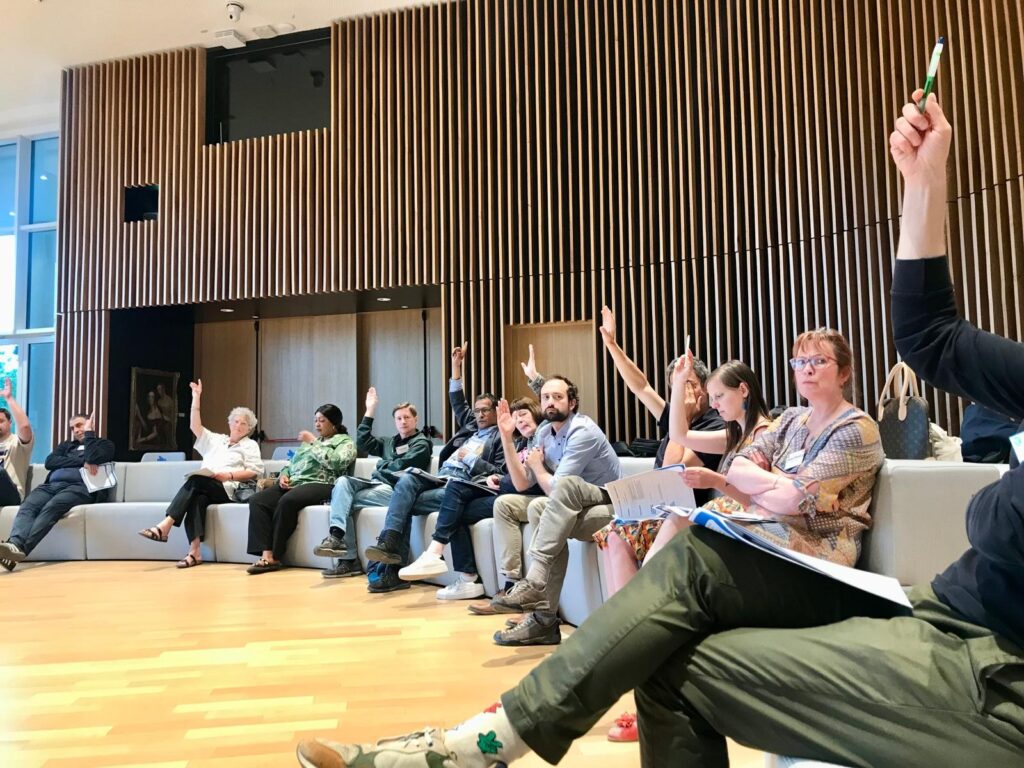
About a month later, on 26 June 2025, the second workshop shifted attention to the long-term delivery of carbon removals.
Here, participants:
Established principled foundations for a long-term finance framework, debating concepts such as the polluter-pays principle, climate integrity, and a transition toward a net-negative economy.
Evaluated three policy approaches: an EU removals trading scheme, extended producer responsibilities, and permanent removal targets within a revised EU Effort Sharing Regulation.
Took on the role of EU legislators in collaborative drafting sessions to articulate credible policy text for future compliance instruments.
The structured nature of these discussions, guided by Dreamocracy’s expertise, meant the resulting dialogue was both technically rich and policy-relevant, directly feeding into legislative considerations.
The policy co-creation process: structured, inclusive, and impactful
As outlined in CO2ol Down Phase 2 rules, the co-creation involved a multi-step process:
Preparation and recruitment of participants representing different sectors.
Two full-day in-person workshops in Brussels.
Intermediate and post-workshop editorial board consolidation of conclusions and draft proposals.
Iterative feedback loops allowing participants to refine outputs.
This participatory design ensured that the proposals emerging from the process weren’t just expert recommendations but co-owned outcomes, a crucial differentiator of genuine policy co-creation.
C02ol Down Phase 2: how Dreamocracy fostered Collective Intelligence
Carbon Market Watch has made a deliberate effort to listen to a variety of stakeholders and to incorporate their views in its proposals. In the Brussels policy ecosystem, this is a highly unusual and commendable approach.
By designing a process of deliberation that has some key features (see Section 2. below), and by providing facilitators who ensured that the process is respected, CMW has enabled an informed and open dialogue, in which participants were able to express themselves freely, including where they disagreed.
The design of the process and the content of the discussions were largely informed by the choices made by CMW in terms of topics, framing, and priorities.
All views were recorded and taken into consideration by the staff of CMW, which put forward a draft based on the input received and based on its own views on the issue.
Some participants, those taking part in the editorial board, had the opportunity to actively co-draft the proposed draft regulation.
The other participants did not have similar co-drafting roles, but they had the opportunity to commentdirectly on the draft, with the final draft being put together by the staff of CMW and the Editorial Board.
Overall, the process has therefore been highly consultative, with specific moments of and spaces for co-creation.
What’s a co-creative process?
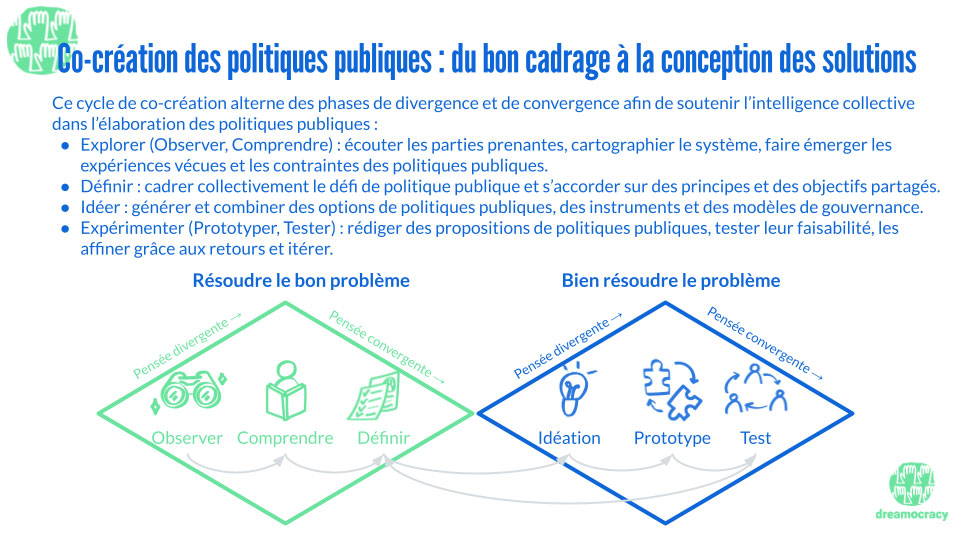
The C02ol Down process – similarly to other design and creative processes – distinguishes between divergent and convergent phases. At each stage – since WS 1 – we have allocated time for both. Interestingly, divergence and convergence do not necessarily operate in a linear process; one can go back to the production of ideas even though some convergence has already taken place. In order to discover which ideas are best, the process is iterative.
As advisors in this process, Dreamocracy sought to ensure that we struck that delicate balance. In short – to keep people motivated and ensure a creative mindset – we wanted to make sure the process allowed participants to build on what has already emerged while leaving room for new input and ideas.
A number of elements in the process allowed for this:
The differentiation between section 1 and section 2 in Drafts 1 and 2.
The possibility for participants and stakeholders to add value, make new comments and proposals through comments.
The organisation of a call between the editorial board (EB) and participants before the finalisation of Draft 2 and the Prototype.
The drafting of emails encouraging the participation of participants and external stakeholders.
We sought to strike this balance while ensuring that key co-creation principles and features were embedded in the process as well, in particular:
End-user focus: We made sure that, once combined, the list of participants and consulted external stakeholders represented the diversity of the financing framework’s end-users.
Transparency: Transparency is key at each stage of such a process. We agreed to collect participants’ and stakeholders’ feedback on online documents through comments, and not suggestions. Clean versions of the different draft legislation also helped participants see the changes that were being made.
Support: We helped CMW, and the EB communicate regularly with participants and stakeholders, justifying the choices and decisions that were being made.
What are the co-creation aspects of C02ol Down Phase 2?
More specifically, in terms of the design of the process, from Session 1 to Session 2 and preparations and follow up, the following elements were cultivated to foster a true co-creation process from beginning to end.
Shared responsibility and common purpose with openness to shape the agenda: The process and each session started with a clarification of the intentions, ways of working, and scope. This shared framework was discussed and agreed with participants, who were invited to extend or challenge its scope. This allowed them to influence the agenda and feel ownership over the process.
Shared principles as a foundation: Before debating policy options, participants agreed on common principles (polluter pays, climate integrity, net-negativity). Establishing shared values created a baseline for constructive collaboration, helping align diverse actors.
Diversity of perspectives:Participants were invited and came from industry, civil society, and academia. This diversity ensured that knowledge, interests, and concerns from different sectors were represented, enriching the debate and avoiding silo thinking.
Structured co-creation methods:Dreamocracy helped design the workshops so that discussions could move beyond debate into collaborative problem-solving. The process combined plenary sessions (to share and hear all voices) and sub-groups (to dive deeper and make concrete proposals). We nurtured in particular the following ingredients:
Iteration and consolidation
Results from the first workshop were summarised by an editorial board, shared with the group for feedback, and then brought back for refinement in the second workshop. This iterative cycle of divergence (many ideas) and convergence (draft conclusions) is central to collective intelligence.
Psychological safety and trust
The format was conducive to psychological safety, with energizers, moments to play and express one’s thoughts and feelings. This allowed participants to feel included and allowed to express dissenting views. In the same spirit, participants were thanked for their open-mindedness and co-creative spirit. Recognition and trust-building are essential ingredients to sustain collective intelligence across sessions.
A shared information foundation
Three policy options were introduced with short presentations, ensuring participants had a shared knowledge base. The group then collectively weighed options against the agreed principles, leading to a collective choice.
Focus on both short-term and long-term horizons
Splitting the work into two workshops (near-term financing vs. long-term delivery) helped structure complex issues in digestible steps, while still linking them.
Critical discussion of feasibility and principles
The group tackled not just technical solutions, but also political feasibility, polluter-pays principles, and governance structures. This broadened the frame from narrow technical fixes to systemic solutions.
Synchronous and asynchronous work, building on prior work
Each workshop did not start from scratch but extended the blueprint from the previous one. The deliverables from each workshop were discussed online. This continuity allowed the group to deepen and refine ideas iteratively, a hallmark of collective intelligence.
Empathy and thinking outside of the box through role-play
By putting the group members “in the shoes of legislators,” by working on a draft piece of legislation, the second session shifted from abstract discussion to practical co-creation. Small groups drafted actual policy text, scrutinised design elements, and tested feasibility.
Synthesis of divergent outputs
Although the three groups produced different drafts, the plenary discussion revealed overlapping elements and convergence toward shared goals. Divergence (exploring alternatives) followed by convergence (finding common ground) is central to collective intelligence.
Fiat Lux! How the two sessions triggered greater Collective Intelligence
We actually saw clear moments when CI emerged, for instance:
During the first workshop (22 May 2025)
Diverse experts engaged in structured dialogue, contributed their knowledge, and identified both constraints and opportunities for financing carbon removals.
In the sub-group discussions
Participants jointly examined eligibility criteria, governance, financing sources, and instrument types—producing richer, more robust ideas than any single expert group could alone.
In the iterative handover to the next session
Results were not left as a one-off, but consolidated into a draft to be refined collectively at the 25 June workshop. This shows collective learning over time.
At the start of workshop 2 (26 June 2025)
Principles were defined collectively, creating a shared compass.
In plenary sessions
Different points of view and drafts were compared, common ground was identified, and a collective sense of purpose emerged.
Through the editorial consolidation process
Outputs from multiple groups were merged into a single proposal, ensuring the final result is a collective product, not the view of one perspective or group.
Overall, the process brought together by CMW, with the help of Dreamocracy, was an intense, careful and unique attempt within EU policy-making circles to overcome the limitations of traditional interest group bargaining and create novel, converging policy options for the benefit of the EU policy making process.
What comes next: shaping EU policy on carbon removals
The outputs from these workshops, now being consolidated by an editorial board, will be packaged as policy proposals to EU policymakers. Rather than presenting a single top-down solution, these proposals reflect a shared, co-created vision for equitable, effective, and climate-integrity-aligned financing of carbon removals.
This co-creation approach helps fill a policy gap at the EU level: crafting a regulatory and financing framework for removals that can support the EU’s climate goals while addressing the complex ethical, technical, and economic challenges.
Why this matters for climate policy
With global markets forecast to grow significantly, potentially reaching billions of dollars annually, the debate around how to finance and govern carbon dioxide removals is no longer academic. Broader analyses show the global carbon removal market could expand dramatically in coming years.
By anchoring policy design in co-creation, Dreamocracy and Carbon Market Watch are helping ensure that emerging frameworks are inclusive, resilient, and more likely to gain legitimacy among stakeholders. This collaborative energy sets a powerful precedent for future climate policy development across the EU and beyond.
Cookies are small text files that can be used by websites to make a user\'s experience more efficient. The law states that we can store cookies on your device if they are strictly necessary for the operation of this site. For all other types of cookies we need your permission. This site uses different types of cookies. Some cookies are placed by third party services that appear on our pages.
Necessary cookies help make a website usable by enabling basic functions like page navigation and access to secure areas of the website. The website cannot function properly without these cookies.
Marketing cookies are used to track visitors across websites. The intention is to display ads that are relevant and engaging for the individual user and thereby more valuable for publishers and third party advertisers.
Preference cookies enable a website to remember information that changes the way the website behaves or looks, like your preferred language or the region that you are in.