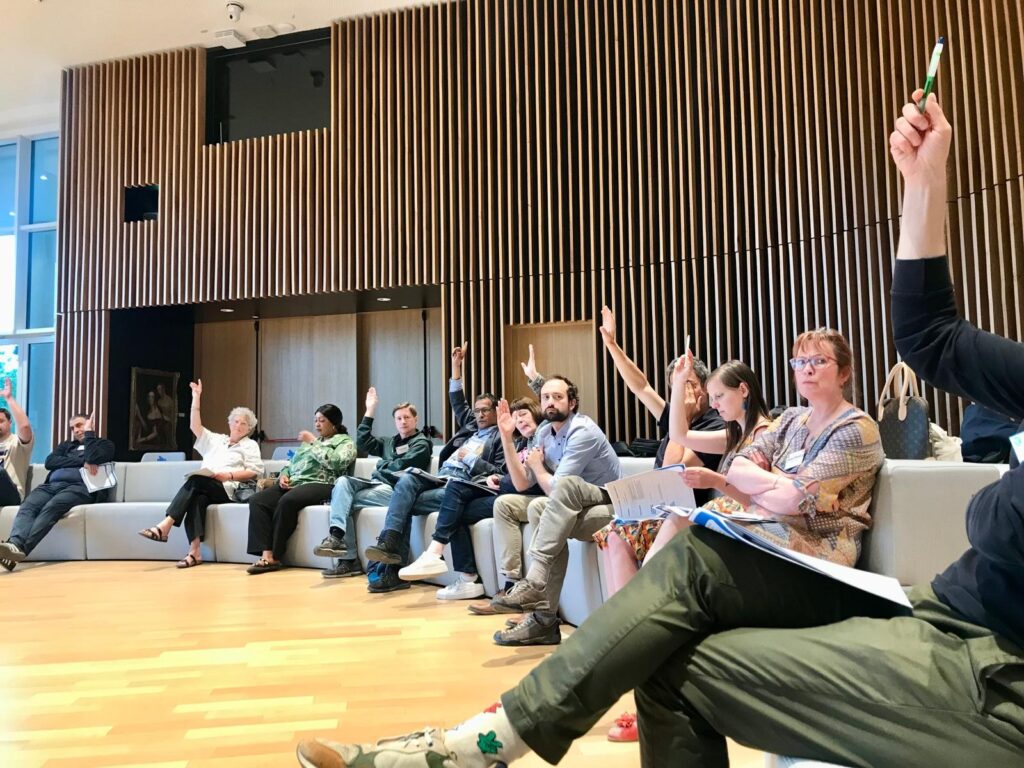
Between September 2024 and June 2025, the municipality of Etterbeek organised neighbourhood councils for its residents, with the support of Dreamocracy. Residents of the Jourdan, Saint-Pierre and La Chasse neighbourhoods were invited to share their views and suggestions on how to improve life in Etterbeek. During the meetings, 60 citizens came together to collectively discuss local policy in their neighbourhood. Discussions focused on culture and local businesses, addressing specific challenges such as: how can we prevent shop vacancies? How can we encourage customers to shop locally? How can we better communicate the municipality’s cultural offerings? And how can we strengthen ties between different cultures and generations through cultural events?
Having supported its neighbourhood councils, Dreamocracy has been working with the municipality of Etterbeek since 2025 on the design and facilitation of its Mobility, Health and Climate advisory councils.
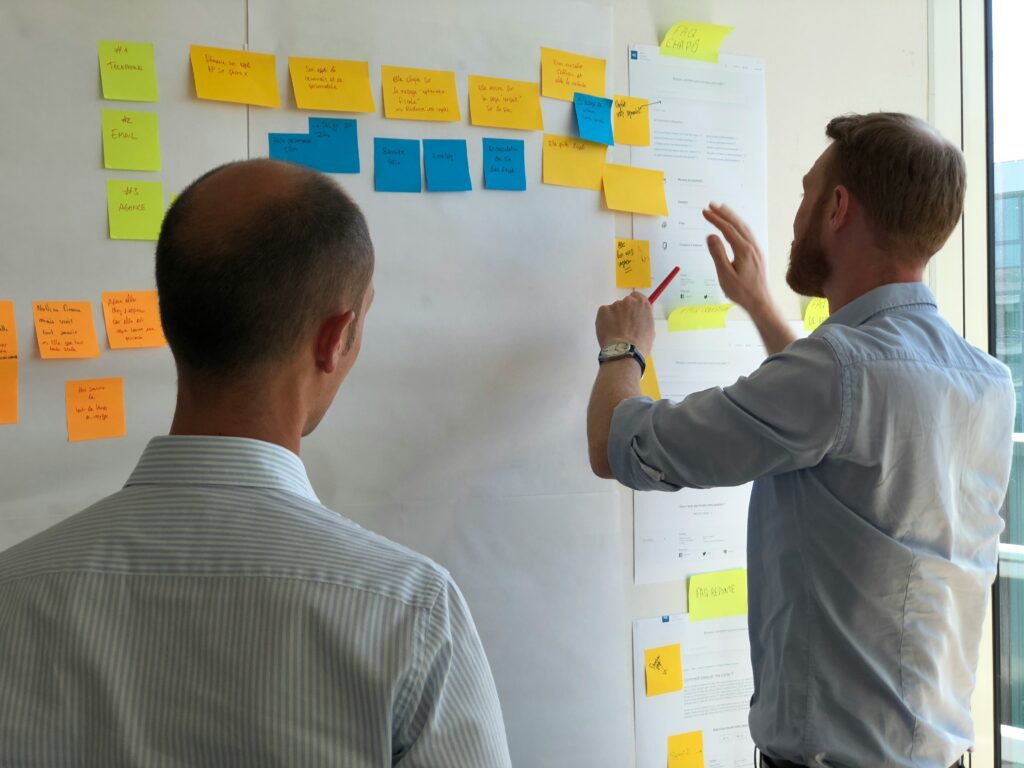
Randomly selected Etterbeek residents, representatives of non-profit organisations, and stakeholders such as shopkeepers engaged in rich and constructive discussions facilitated by Dreamocracy. They worked with methods such as “photolanguage,” a technique that helps address complex topics in an inclusive way. Citizens also practised creative methods to break out of familiar ways of thinking and come up with new ideas. Throughout the process, municipal staff and aldermen were also present to share information about what is already happening in the municipality, explain the competences of the local administration, and share their experience. These exchanges ultimately led to concrete proposals to tackle the identified challenges.
Each council brings together a panel of citizens selected at random, appointed for a two-year term to formulate concrete recommendations. Designed as forums for constructive dialogue between citizens, the local authority and elected representatives, these councils aim to produce useful and feasible proposals.
From the outset, the local authority proposes areas of focus where it knows it can take citizens’ recommendations into account and implement them. Participants choose from these areas, whilst also having the freedom to develop others. This is what happened with the Health and Mobility councils: for each, two areas were selected – one proposed by the local authority, the other by the citizens.
A structured process to inform, create and formulate recommendations
To focus their thinking within the broad theme proposed, citizens begin by choosing an area they wish to explore in depth. Once chosen, they gather information on this area, with the support of local council staff and elected representatives.
This is followed by an idea-generation phase, supported by activities designed to stimulate creativity and think outside the box. Participants notably experimented with the persona method, which involves putting oneself in another person’s shoes in order to approach challenges from a different angle.
Finally, they select the most promising ideas and develop them further to turn them into concrete recommendations.
At every stage of the process, we organise opportunities for dialogue and feedback between participants, council staff and elected representatives, whilst preserving citizens’ initiative and freedom.
Neighbourhood councils: transparency and long-term monitoring
Once proposals have been drawn up, they are forwarded to the municipal council, which provides written feedback. On this basis, citizens are free to decide how to finalise their recommendations.
The two-year term also allows for the introduction of a follow-up mechanism, which is still too rare in the majority of participatory initiatives. Each council works on an initial set of recommendations during the first year. At the end of the second year, the local authority commits to a follow-up session with participants to share the progress made in implementing the recommendations formulated during the first year.