La créativité politique est une capacité que possèdent des groupes ou des individus pour produire des solutions aux problèmes publics qui sont à la fois utiles et originales. Cela résume tout, mais il vaut la peine d’examiner chacun de ces éléments plus en détail.
Nous visons, en particulier lorsqu’il s’agit de problèmes publics complexes, de véritables solutions, et non seulement des idées. La capacité à développer des solutions est le point de départ. En fin de compte, ce que nous recherchons, c’est la mise en œuvre de ces solutions. Une fois que nos idées voient le jour, elles deviennent des innovations. Ces innovations peuvent être de différentes natures. Nous avons besoin d’innovations sociales, c’est-à-dire d’innovations qui modifient les relations sociales et reposent sur l’implication des individus sur le terrain. Nous avons également besoin d’innovations politiques, c’est-à-dire de nouvelles politiques qui répondent aux enjeux actuels. Pour les favoriser, nous avons aussi besoin d’innovations en matière de gouvernance, c’est-à-dire de nouvelles façons démocratiques de recueillir les préférences et de prendre des décisions. Plus précisément, nous avons besoin d’innovations démocratiques, c’est-à-dire d’innovations en matière de gouvernance qui favorisent des formes plus démocratiques de prise de décision.
La créativité, en tant que capacité à résoudre des problèmes, est une forme d’intelligence. Nous manifestons tous différentes formes de créativité, tout comme nous avons différentes formes d’intelligence.
Alors que l’intelligence collective est la capacité des groupes à surpasser les individus dans la résolution de problèmes, l’innovation, la prédiction, la créativité et d’autres tâches cognitives, la créativité collective est la capacité qu’ont les groupes à produire des solutions à la fois plus novatrices et plus impactantes que celles de leurs membres pris individuellement.
La créativité collective est donc un type, un sous-ensemble de l’intelligence collective. Plus précisément, ce que nous visons chez Dreamocracy, c’est la créativité politique collective. Tout comme il existe une intelligence politique collective, que la professeure Eva Sørensen définit comme « une compréhension réaliste et approfondie des désaccords, de ce qu’il faudrait pour prendre des décisions qui satisfassent plusieurs points de vue et des coûts associés aux décisions qui créent des perdants », nous considérons la créativité politique collective comme la capacité des groupes à produire des solutions nouvelles et utiles aux défis publics.
Lorsque les membres de l’équipe présentent ce que fait Dreamocracy, les gens réagissent souvent en disant : “la créativité politique, c’est un oxymore”. La créativité en politique est-elle une aspiration ou une réalité ? En fait, comme cela a été documenté, il y a beaucoup de créativité en politique qui passe inaperçue, probablement parce qu’elle est difficile à capter par les médias.
Alors, comment reconnaître la créativité dans le domaine des politiques publiques lorsque nous la rencontrons ? Qu’est-ce qui qualifie une politique publique, un décideur politique ou une solution “créative” ? Pour nourrir notre créativité collective, nous devons mieux la comprendre.
D’après notre expérience, une innovation dans le secteur public (politique, gouvernance ou autre) doit cocher toutes les cases suivantes, faute de quoi les gens et l’histoire ne se souviendront pas qu’elle a été créative. En plus d’être originale et utile, elle doit être :
- Efficace. Si elle est nouvelle et a un impact, mais qu’elle est plus coûteuse (financièrement ou autrement) que les approches précédentes, elle ne sera pas considérée comme créative.
- A l’heure. Avoir raison trop tard ne sert à rien. Un système politique créatif aborde les problèmes avec des solutions meilleures et plus efficaces à temps.
- Agile et persévérant, car certaines solutions nouvelles peuvent apparaître trop tôt et doivent être adaptées au fil du temps pour répondre à de nouvelles circonstances.
- Transversale, c’est-à-dire qu’elle doit minimiser les dommages et maximiser les bénéfices collatéraux, par opposition à la pensée linéaire qui aborde une question mais crée des problèmes ailleurs. Pensez aux propositions du type “Trop d’immigrés ?” “Construisez un mur !”…
- Persistante, par opposition aux solutions rapides, à courte vue, qui n’ont pas l’effet durable désiré.
Bien reçue. La meilleure solution du monde sera inutile si elle n’est pas comprise et si elle est finalement rejetée par les parties prenantes concernées.
The 22 cases presented in the handbook have in common 5 key steps that should be followed in order to produce better outcomes, beyond the ideation phase which is only one of the 5 steps.
1. Clarifying what the issue is and agreeing on a definition of the problem at hand. Too often the various stakeholders rush to discussing possible solutions and get stuck on ideological grounds, without having properly defined the issue, how it relates to other issues, what are its different dimensions, etc.
2. Then comes the idea generation phase. People usually associate this phase with the creative process, as a whole. It’s only a part. A brainstorming session has never solved a social crisis. This phase involves first multiplying options, and then selecting among this enlarged pool of options.
3. Testing ideas out, experimenting, prototyping, and, most importantly, evaluating: The ensuing step is crucial, as being creative, especially in politics, necessitates a high tolerance for risk and minimal fear of failure. Creative entrepreneurs are not afraid of failing, because failure is a necessary prerequisite for success. No idea, solution or business model is perfect to begin with, and trial and error is the only way of advancing in an uncertain environment. An important factor here is the courage of being vulnerable, as “vulnerability is the birthplace of innovation, creativity and change”.
4. Generating buy-in for the resulting ideas in the public arena. Many “good” ideas have been rejected by the stakeholders concerned by the issue, because a vocal minority or majority of them were not involved in developing them, or disagreed with them. This is a phase that should in fact run in parallel to the other 4 phases.
5. Scaling up the new solutions thus developed. Once a community has agreed on the problem at hand, on novel solutions to address it, has accepted their necessity, and tried them out (at a local level, or for a short period of time, etc), a crucial condition for innovative policy making is the ability to unroll those solutions on a large scale and for a longer period of time.
Similar to the Creative Problem Solving (CPS) approach, each of these steps can be divided into a divergence and a convergence sub-phase, first multiplying options, then selecting them. We believe however, contrary to CPS’s 4 steps (clarification, ideation, transformation, implementation), the transformation and implementation phases need to be tailored to the specificities of political battles, by taking into account the crucial importance of testing, communicating and scaling.
At each of these 5 steps, a proven method for innovation has been an “out of the box” mindset. A second condition for creativity, mostly lacking in the political bubble, is empathy. Studies have shown that creatives flourish in empathetic environments, because empathy is conducive to creative thought. Politics, on the other hand, is all too often a toxic, hostile environment where the strongest person survives. This is counterproductive and a poison for creativity.
When fostering collective creativity in an organisation that seeks to address complex public problems – whether a public administration, an NGO, an interest group, a political party, or other – some key principles are worth keeping in mind.
First, as Harvard Business School Professor Teresa Amabile has pointed out, one wants to make sure not to kill the potential for creativity. That means aligning three key ingredients of a creative mindset in an organisation: expertise – creative skills – motivation (Harvard Business Review, Sept.-Oct. 1998).
Whereas expertise is what most organisations nurture and identify most readily, creative skills are starting to be identified as crucial to public bodies and other contributors to policy making. Hence the interest in approaches such as design thinking since IDEO’s pioneering efforts in the USA or Christian Bason’s in Denmark’s MindLab, the former Danish government innovation lab (2007-2014).
What is more difficult to nurture is the right level of motivation that unleashes people’s talents and desire to contribute their best ideas. For that, Amabile insists on setting the right level of challenges for team members. Not too hard, but not too easy either.
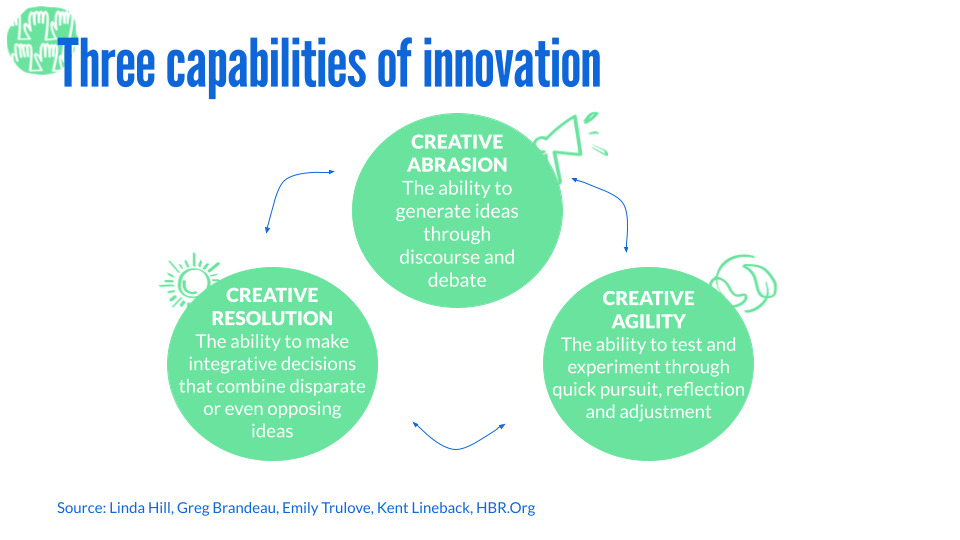
Furthermore, Prof. Linda Hill, also of the Harvard Business School, has found that innovative organizations function as communities with three key capabilities: creative abrasion, creative agility, and creative resolution. Creative abrasion involves fostering a marketplace of ideas through active debate and discourse. Rather than minimizing differences, these organizations amplify them. This process goes beyond traditional brainstorming, where judgment is deferred. Instead, it encourages heated yet constructive arguments to generate a diverse range of alternatives.
Motivation is certainly not just about stimulating challenges and positive reinforcement. It is also about frank conversations. Hill insists on abrasion, which she defines as “the ability to generate ideas through discourse and debate”. Creative abrasion is reinforced by creative agility, “the ability to test and experiment through quick pursuit, reflection, and adjustment”. And, finally, abrasion and agility need creative resolution, “the ability to make integrative decisions that combine disparate or even opposing ideas”.
Dreamocracy’s team members have all been trained in Creative Problem Solving, one of the leading schools in the study and practice of creativity. Within this broad approach, we have used well-honed practices and developed our own. Rather than list all the types of creative hammers, screwdrivers and wrenches in our toolbox, here is an overview of the broad families of methods that we use and adapt according to specific public challenges.
Divergent, creative thinking techniques can indeed be grouped into several families based on their underlying mechanisms. Research in psychology, creativity studies, and innovation theory has documented many such approaches.
1. Analogical Thinking – Involves drawing parallels between unrelated or distantly related concepts to generate new insights or ideas. Analogical reasoning taps into the brain’s ability to make associations across seemingly different concepts, helping to solve problems by transferring knowledge from one domain to another. Techniques:
– Metaphor and simile: Using figurative comparisons to connect ideas from different domains. We use metaphors and quotes a lot.
– Biomimicry: Applying nature’s solutions to human problems is a well-documented and powerful approach.The best known example is probably Velcro inspired by burrs.
– Forced analogy: Forcing a connection between unrelated concepts to spark new ideas. Like simply opening a book and connecting our challenge with the first word that our eyes come across. What do you think when you’re thinking about “social housing” and your eyes come across the word “caramel”?
2. Intuition-based thinking – Encourages relying on gut feelings, insights, or subconscious processes, often in the absence of logical reasoning. Intuition-based thinking leverages unconscious cognitive processes, often supported by research on incubation, the idea that taking breaks from problem-solving can lead to spontaneous insights. Techniques:
– Meditation and mindfulness: Clearing the mind to allow intuitive thoughts to surface is very effective. Not all groups of civil servants or activists are comfortable with taking time to be present in the moment. But we try…
– Dream journaling: Capturing thoughts from dreams to fuel creativity works for everyone. Have you never woken up with a great insight?
– Flow state: Engaging in a task to the point where ideas emerge naturally and effortlessly is both effective and very pleasant. We give a lot of time to our groups to think in silence. Talking is great, but thinking in silence, focused, can be far more productive.
– Photolanguage: This is the art of using pictures to stimulate new, more intuitive connections. Note: we love it.
3. Associative thinking – Involves generating new ideas by making spontaneous connections between seemingly unrelated concepts. This technique taps into the associative networks of the brain, promoting connections that may not be immediately obvious, as studied in creative cognition. Techniques:
– Word Association: Writing down words that come to mind in response to a starting concept.
– Mind Mapping: Creating a visual diagram to explore associations and relationships between ideas.
– Brainstorming: Generating as many ideas as possible without criticism, encouraging associative leaps.
4. Disruptive thinking (aka ‘Lateral Thinking’) – Challenges established patterns or logical sequences to generate novel perspectives by breaking conventional rules. Disruptive thinking can break mental fixedness and encourage exploration outside routine thought patterns, a phenomenon supported by research into lateral thinking, as coined by Edward de Bono. Techniques:
– Provocation: Making deliberately outrageous or irrational statements to shift perspective.
– Six Thinking Hats: Approaching problems from multiple viewpoints (e.g., emotional, logical, creative).
– Reversal: Reversing common assumptions to see problems from an entirely different angle.
5. Pattern recognition and systems thinking – Involves detecting patterns or seeing the whole system to create solutions or generate new ideas. This approach is supported by research into how the brain recognizes patterns and structures in complex systems, fostering creativity by revealing hidden relationships. Techniques:
– Pattern Identification: Observing repeating structures or processes in nature, technology, or human behavior.
– Systems Mapping: Drawing connections between different parts of a system to reveal new opportunities.
– Fractal Thinking: Recognizing recurring patterns at different scales.
6. Constraint-based creativity – Imposes artificial or real constraints to stimulate creative thinking by forcing problem-solvers to think within boundaries. Cognitive science has shown that constraints can paradoxically enhance creativity by reducing choice overload and focusing cognitive resources on problem-solving within specific boundaries. Techniques:
– SCAMPER: A checklist that encourages thinking about how to Substitute, Combine, Adapt, Modify, Put to other uses, Eliminate, or Rearrange elements of an existing idea.
– Limitations on Time/Resources: Forcing solutions within strict time or resource limits.
– Creative Writing Prompts: Using a specific prompt to limit focus and stimulate new ideas.
7. Visual and spatial thinking – Engages the brain’s visual and spatial faculties to generate ideas. Visual and spatial thinking activates different parts of the brain than verbal thinking, opening new avenues for creativity and idea generation. Techniques:
– Sketching/Drawing: Translating abstract ideas into visual forms to inspire new ideas.
– Visualization: Mentally picturing the outcome or process to generate creative insights.
– Lego Serious Play: Using physical objects to model abstract ideas.
8. Randomness and serendipity – Introduces random or unexpected elements to break conventional thought patterns. Research into serendipity in creativity shows that encountering unexpected information can lead to spontaneous insight by disrupting habitual thinking. Techniques:
– Random Word or Image Generator: Using random stimuli (e.g., words or images) to inspire new directions.
– Serendipity Walk: Taking a walk to randomly encounter stimuli that spark new ideas.
– Oblique Strategies: Using a deck of cards with cryptic prompts to push thinking in unexpected directions.
9. Collaborative thinking (aka group creativity) – Relies on collective idea generation where diverse perspectives from multiple individuals combine to create novel ideas. Collaborative thinking harnesses the diversity of thought within groups, and research on group creativity shows that social interaction can spur creative problem-solving, though it requires overcoming potential challenges like groupthink or dominant voices. Techniques:
– Brainwriting: Group members write down ideas independently and then share them to inspire further thinking.
– Collaborative Sketching: Groups collectively draw out ideas, iterating on one another’s contributions.
– Nominal Group Technique: Gathering individual ideas independently before discussing them as a group to avoid groupthink.
10. Play and gamification – Uses playful or game-based methods to stimulate creativity by reducing inhibitions and encouraging exploration. Play activates the brain’s reward systems, fostering experimentation and exploration, which leads to more flexible, divergent thinking. Techniques:
– Role-Playing: Pretending to be someone else to approach a problem from their perspective.
– Creative Games: Structured activities that challenge participants to think creatively within a game format.
– Improv: Using improvisational techniques (e.g., in acting or music) to stimulate spontaneous creativity.
11. Reframing and perspective shifting – Involves looking at a problem from a completely different perspective to uncover new solutions. Cognitive research shows that changing the mental framing of a problem can lead to different mental pathways for solutions, often allowing for creative breakthroughs.
Techniques:
– Problem Reframing: Asking “What if?” or changing the way a problem is framed.
– Empathy Mapping: Seeing a problem from the perspective of a different stakeholder or persona.
– Opposite Thinking: Considering the opposite or inverse of the current idea.
How can we reform our institutions and political culture in order to place creativity at the heart of politics?
Collective creativity and intelligence can be mindfully tapped into. However, to change the whole political system to make it more conducive to fostering, supporting and disseminating creativity, more needs to be done at a structural level, to foster a constructive operational environment for creative policy makers. At Dreamocracy, we recommend the following 6 reforms.
Make creativity and political innovation a priority. Think “Liberté, égalité, fraternité, créativité”! Putting creativity at the heart of our political system is far more than a “new New Public Management” technique. It is an antidote to populism and to people’s mistrust in democratic governance.
Acknowledge complexity and develop the tools to embrace it. Policy makers, generally speaking, shy away from complex messaging. This is understandable. However, in a complex, VUCA world, we need to find holistic solutions that transcend specific issues, geographies, actors. Creativity can help come up with better solutions, if dare steer away from simplistic reasoning and messaging.
Involve relevant stakeholders using the experience gained in terms of effective participatory democracy techniques.
Teach creativity to civil servants and public leaders.
Organize the State and institutions as a catalyst of creativity in society.
Use creativity to make politics more appealing.