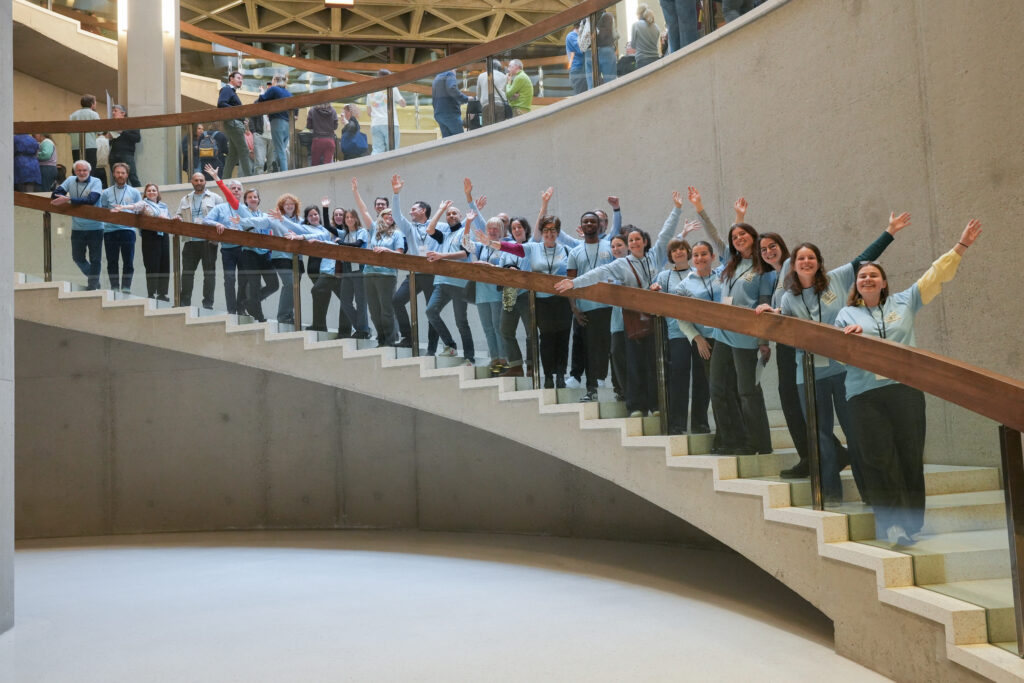
How can a university of 40,000 people make collective decisions about its own future? The Université libre de Bruxelles (ULB) chose to find out. Dreamocracy led the ULB’s “Assemblées libres”, a large-scale participatory governance process running from February to April, 2026.
Bringing together students, professors, researchers, and staff, the process used citizens’ assembly methodology to generate concrete, collectively validated recommendations for institutional transformation, and offers a replicable model for higher education institutions worldwide.
Stage 1. Surveying the community: mapping priorities and lived tensions
The process began with a university-wide survey, open to all members of the ULB community (students, teaching staff, researchers, and administrative, technical, and specialist staff), combining open and closed questions designed to surface lived tensions, perceived urgencies, and future-oriented aspirations. It attracted 1,855 quality-controlled responses, providing a robust and representative picture of the community’s priorities.
Based on these findings, two central challenges were formulated as guiding questions for the subsequent deliberation:
- Challenge 1 — “What priorities should our university set to maintain and strengthen the quality of its teaching and research in a world undergoing profound transformation?”
- Challenge 2 — “What priorities should the university set to reduce stress, combat inequalities, and foster a better quality of life for students and staff?”
Stage 2. The Tables libres: large-scale deliberation in higher education
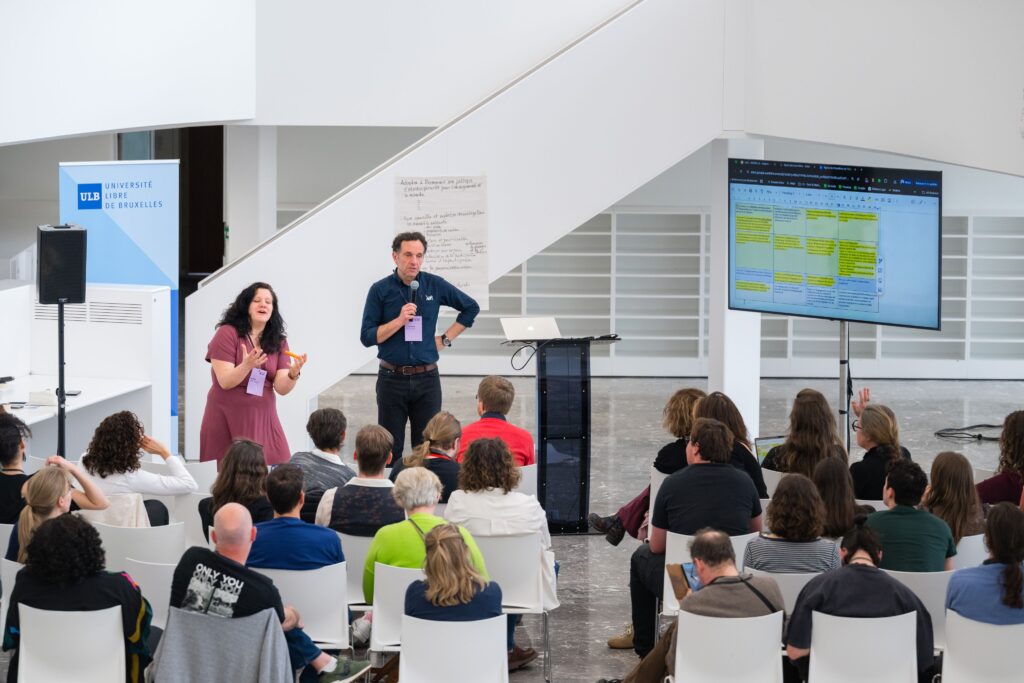
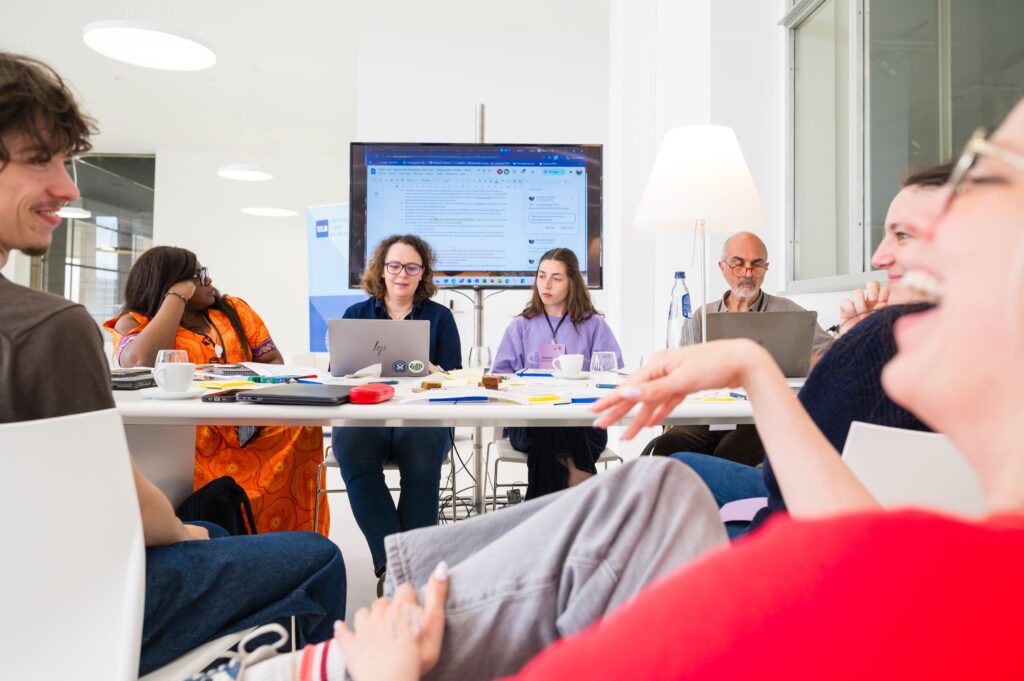
The Tables libres took place on March 10, 2026, bringing together just under 200 members of the university community for a full day of structured dialogue. Students, academics, researchers, and administrative staff participated side by side, providing a unique moment of cross-community deliberation in a higher education setting.
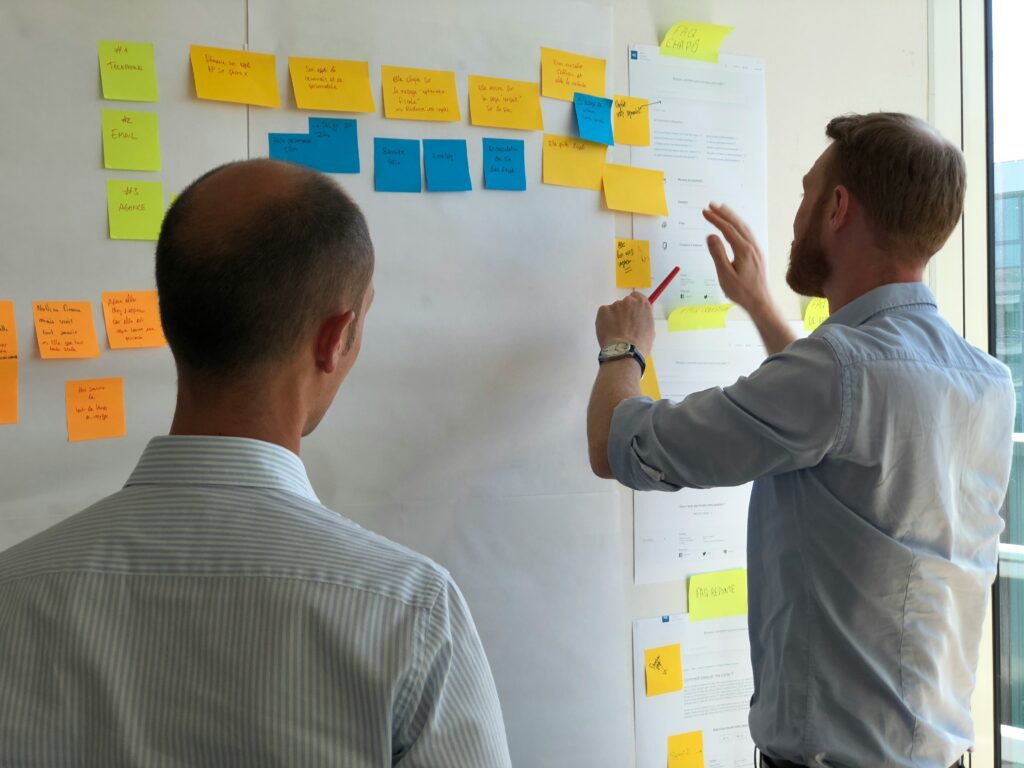
Inspired by World Café principles and adapted to the realities of university governance, participants worked in diversified sub-groups and were invited to:
- Exchange observations: sharing and cross-examining perspectives on each of the two challenges;
- Imagine a vision: sketching forward-looking directions for the ULB;
- Propose orientations and action pathways: developing concrete directions that could bring the university closer to its envisioned future.
As the day progressed, discussions moved from diagnosis to direction, producing draft proposals that became the foundation for the university assembly that followed.
Stage 3. The Agora des possibles: a stratified citizens’ assembly for the university
The Agora des possibles was composed of 50 participants selected through a structured random draw from approximately 300 volunteers, ensuring the panel represented the full diversity of the university community — 16 students, 16 academics, 8 researchers, and 10 PATGS staff members — with a secondary stratification layer integrating campus realities, faculties, and study levels.
Given the breadth of material gathered during the Tables libres, the scope of the Agora’s work was refined, with the support of the Rector’s office, into two focused questions:
- Question 1 — “How should ULB transform its teaching formats, foster interdisciplinarity and organise curricula to improve learning quality, strengthen research and evolve the academic model? (Including: How should assessment methods be rethought to improve learning?)”
Question 2 — “What concrete actions should be implemented to strengthen equal opportunities? (Including: What priority measures should be put in place to combat discrimination and guarantee an inclusive environment?)”
Three days of deliberation: how the university assembly worked
The Agora des possibles met over three full days — March 28, April 11, and April 18, 2026. Each day had a clear purpose within the deliberative process.
Day 1 — Understanding the context
Participants set shared working principles, revisited the outputs of the Tables libres, and received institutional context from experts: Simon Detterman (strategic support directorate) and Bastien Scorneau (financial management department). The goal was to ground the deliberation in real constraints (budget realities, institutional data, existing rules,…), before moving toward proposals.
Day 2 — Exploring possibilities
Expert witnesses responded directly to questions raised by the group on Day 1:
- Sophie Lecloux, Pedagogical Adviser at the Centre d’appui pédagogique;
- Charlotte Claes, Deputy Head of the Teaching Department;
- Alain Lévêque, Emeritus Professor and Adviser on Inclusion to the Rector, former Vice-Rector for Student Affairs.
Participants then identified four major strategic orientations through individual reflection, collective discussion, and a vote. Sub-groups began structuring recommendation pathways for each axis. Between Days 2 and 3, participants inventoried existing initiatives and continued developing their proposals.
Day 3 — Converging on recommendations
Sub-groups developed four to six concrete proposals per axis, then rotated to hear and enrich each other’s work. A shared preamble was co-drafted, and each recommendation was assessed for its relevance to the two mandate questions.
The day concluded with a preference vote, in which every member of the Agora evaluated each recommendation across three criteria — relevance, personal sentiment, and urgency of implementation (on a 1-to-5-year scale). Immediately after, the members of the Agora des possibles formally handed their recommendations to the ULB Rector’s team.
The recommendations: four strategic priorities for university transformation
The citizens’ assembly produced a structured set of recommendations organised around four strategic axes, each reflecting broad consensus on both relevance and urgency.
Axis 1: Adopt and promote an interdisciplinarity policy for teaching and research
The deliberative process surfaced a strong expectation that disciplinary silos be dismantled. Current faculty-based structures are seen as a brake on collaboration, coherent curricula, and transversal projects. The Agora recommends that ULB make interdisciplinarity a structural priority — by revisiting faculty structures to create space for interdisciplinary entities with real staffing and funding capacity; facilitating mobility and dialogue between institutional bodies; promoting interdisciplinary projects linked to real-world problems; removing promotion and funding barriers that currently penalise non-disciplinary profiles; developing an interdisciplinary minor system; and composing a harmonised common core rooted in critical thinking, ethics, and ULB’s core values.
Axis 2: Make equality, diversity, inclusion, and well-being a transversal strategic priority
The Agora identified a persistent gap between ULB’s stated values and its institutional practices, particularly regarding accessibility, support, and working conditions. Recommendations call for creating a dedicated transversal strategic department for well-being, inclusion, diversity, and sustainability; conducting a comprehensive audit of existing support devices for students and staff; developing an ambitious campus transformation plan; improving conditions and recognition for PATGS and outsourced staff; fostering innovative pedagogy that promotes learning rather than anxiety; and making first-year student support a genuine institutional priority.
Axis 3: Strengthen internal democracy and participation (rebuilding dialogue and trust)
Participants identified a felt disconnection between the university community and its governance structures, alongside opacity and undervalued representative roles. The Agora recommends improving transparent, accessible communication across all bodies; better recognising and compensating the engagement of student and staff representatives; training the whole university community in democratic culture and ULB’s governance structures; and institutionalising a permanent participatory democracy device, combining sortition, neutral facilitation, and online consultation tools.
Axis 4: Intensify ULB’s engagement in its third mission, embodying its values as a force for inspiration and counter-power
In response to growing external pressures, the Agora called for ULB to act as a genuinely engaged institution in the public sphere. Recommendations include creating a cross-body “Third Mission and Values” body to monitor alignment between stated values and actual practices; acting strategically through common fronts with peer institutions and selective funding choices; actively defending social justice through transparent governance, support for affected community members, and civic mobilisation; and formally recognising third-mission engagement in workload frameworks and career criteria for all university bodies.
A distinctive feature of this university assembly: alumni as trained co-facilitators
One of the innovative elements of this participatory process was the mobilisation of ULB alumni as trained co-facilitators. Having received facilitation training beforehand, they supported the Tables libres and contributed meaningfully to deliberative quality throughout.
This approach brought several distinct advantages to the citizens’ assembly design. It created genuine intergenerational continuity: alumni who graduated decades ago (some more than 60 years ago!) returned in a new role, linking institutional memory with present-day concerns in a single deliberative space. It introduced an external perspective without full externalisation: alumni are no longer embedded in daily university dynamics, giving them distance and neutrality, while their connection to ULB’s culture ensured that discussions stayed grounded. And it built lasting facilitation and participatory governance capacity skills that extend beyond this process and can support future university reform initiatives.
What Dreamocracy delivered
- End-to-end design and facilitation of a large-scale citizens’ assembly process
- Facilitation of large-group deliberative formats (World Café, stratified citizens’ assembly)
- Capacity building and training of alumni co-facilitators
- Development of prioritised, actionable recommendations through collective intelligence
Impact: a replicable model for participatory governance in higher education
The Assemblées libres demonstrate what is possible when a university commits to genuine participatory governance. Over 1,855 community members contributed to the initial survey, nearly 200 took part in the deliberation day, and 48 citizens’ assembly members spent three full days producing recommendations that are both evidence-informed and community-owned.
The resulting recommendations, spanning interdisciplinarity, inclusion, internal democracy, and societal engagement, reflect the output of a structured, multi-stage deliberative process. A preference vote captured not only consensus but the perceived urgency of each measure, giving the Rector’s team a nuanced picture of community priorities.
Beyond ULB, this initiative offers a tested, replicable model for how universities and other large institutions can use citizens’ assembly methodology to navigate complex transformations using collective intelligence.
Frequently Asked Questions About the ULB University Assembly
What is a university assembly?
A university citizens’ assembly is a small deliberative body composed of members of the university community (students, faculty, researchers, and staff) selected by stratified random sampling to represent the institution’s diversity. At ULB, the Agora des possibles brought together 50 participants to formulate recommendations on the future of the university.
How does stratified random selection work in a university assembly?
Stratified random selection chooses participants from among volunteers by adhering to quotas by category (students, faculty, researchers, PATGS) and by sub-criteria (campuses, faculties, academic levels) to ensure a representative sample of the community.
Who organiwed the ULB’s university assembly?
The “Assemblées libres” (ULB university assembly) were designed and facilitated by Dreamocracy, in partnership with the Rectorate of the Université libre de Bruxelles, from February to April 2026.
How can university asssemblies, as a model of participatory democracy, be adapted for other universities?
The three-step process (community survey, day of deliberation, followed by a stratified citizens’ assembly) can be adapted to any higher education institution seeking to harness collective intelligence to guide its institutional transformation.
Keywords
University Assembly, participatory democracy, university governance, university reform, citizen deliberation, random selection, higher education, collective intelligence, deliberative mini-public.